Computers have become an essential part of our everyday lives. We use computers for studying, working, communication, entertainment, banking and many other activities.
However, some scientific and technical problems are so complicated that an ordinary computer cannot solve them efficiently.
This is where supercomputers become important.
A supercomputer is an extremely powerful computer designed to perform complex calculations and process enormous amounts of data at very high speeds.
These computers are mainly used in scientific research, weather forecasting, space exploration, medical research, artificial intelligence and national security.
For example, when meteorologists predict a cyclone, they need to analyse huge amounts of weather information, including temperature, wind speed, atmospheric pressure and ocean conditions.
A supercomputer can process this information much faster than an ordinary desktop computer.
During my 5+ years of teaching computer fundamentals, I have noticed that students sometimes confuse supercomputers with ordinary high-performance computers.
The easiest way to understand the difference is that supercomputers are specially designed to solve extremely complex computational problems using thousands of processors working together.
In this article, we will learn about supercomputers, their examples, features, types, uses and real-life applications in simple English.
What Is a Supercomputer?
A supercomputer is a high-performance computer capable of performing extremely large numbers of calculations in a short period.
It is designed to solve complex problems that require enormous processing power, memory and storage capacity.
Unlike an ordinary computer, which generally performs tasks using a limited number of processors, a supercomputer uses thousands or even millions of processing cores working together.
A processing core is an individual unit inside a processor that can execute computing instructions.
Supercomputer performance is commonly measured in FLOPS (Floating Point Operations Per Second). FLOPS measures how many mathematical calculations involving decimal numbers a computer can perform in one second.
Read Also - Types of Computers
The common performance units include:
| Unit | Meaning |
|---|---|
| Kiloflops (KFLOPS) | Thousand calculations per second |
| Megaflops (MFLOPS) | Million calculations per second |
| Gigaflops (GFLOPS) | Billion calculations per second |
| Teraflops (TFLOPS) | Trillion calculations per second |
| Petaflops (PFLOPS) | Quadrillion calculations per second |
| Exaflops (EFLOPS) | Quintillion calculations per second |
Simple Example: A normal computer can handle everyday activities such as creating documents, browsing websites and playing videos.
A supercomputer can simulate complex weather systems, study the behaviour of molecules and perform advanced scientific calculations.
Read Also - Examples of Mainframe Computers
Examples of Supercomputers
Several powerful supercomputers have been developed around the world for scientific research, engineering, artificial intelligence and national development.
Here are some well-known examples of supercomputers.
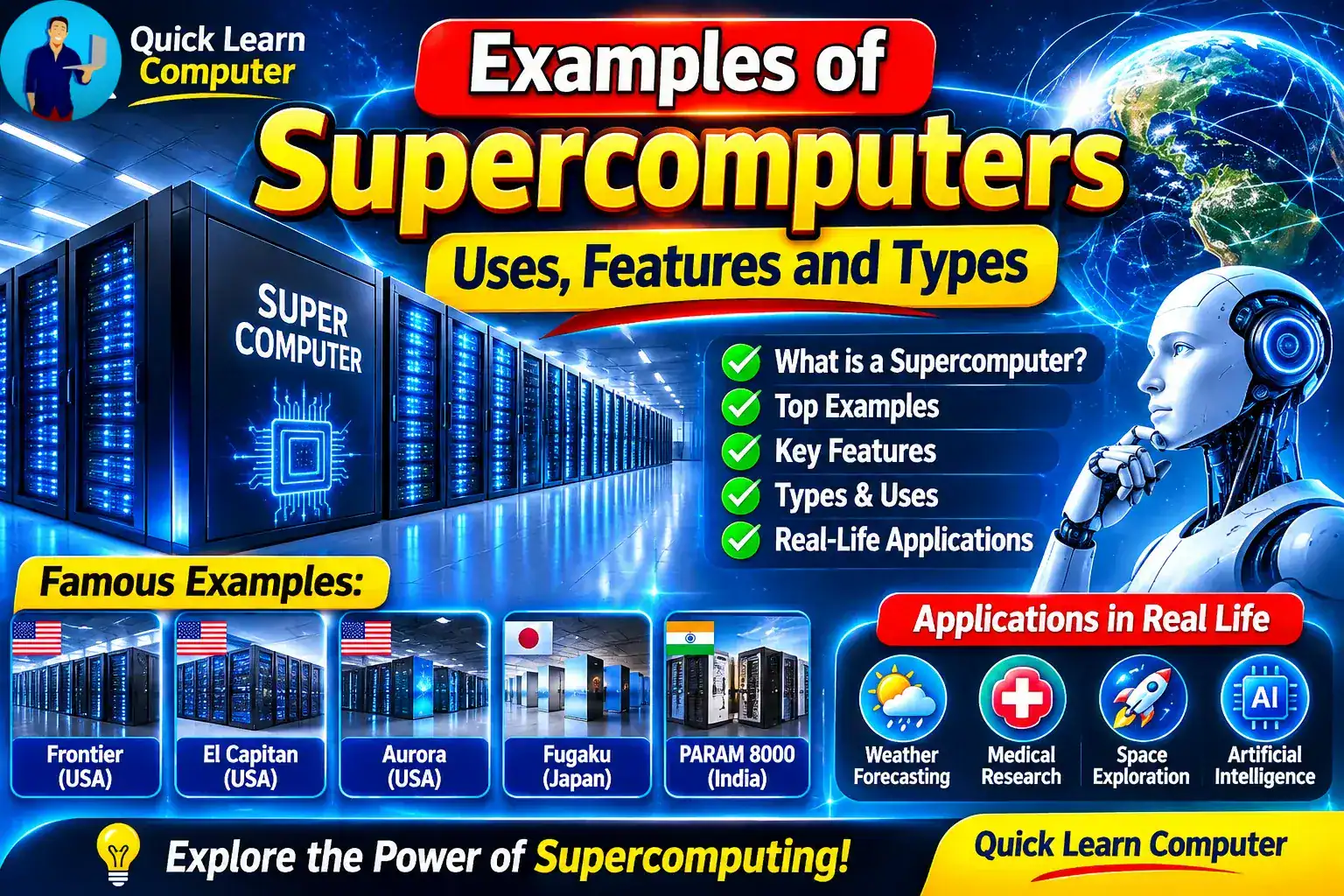
1. Frontier (USA)
Frontier is a powerful supercomputer developed at Oak Ridge National Laboratory in the United States.
It became the first publicly announced supercomputer to achieve exascale performance, meaning it crossed the threshold of one quintillion calculations per second.
Main features:
- Developed for advanced scientific research.
- Uses AMD EPYC processors and AMD Instinct accelerators.
- Supports large-scale scientific simulations.
- Used for research in energy, physics, climate and medicine.
Read Also - Examples of Mini Computers
2. El Capitan (USA)
El Capitan is a high-performance supercomputer installed at Lawrence Livermore National Laboratory in the United States.
It was designed to support advanced national security research and scientific computing.
Main features:
- Uses AMD EPYC processors and AMD Instinct accelerators.
- Designed for extremely complex calculations.
- Supports advanced simulation and modelling.
- Used in national security and scientific research.
Read Also - Examples of Micro Computers
3. Aurora (USA)
Aurora is a supercomputer developed at Argonne National Laboratory in the United States.
It is designed to support scientific research, artificial intelligence and large-scale computational experiments.
Main features:
- Uses Intel Xeon CPU Max processors and Intel Data Center GPU Max accelerators.
- Supports AI and machine learning workloads.
- Helps researchers perform complex simulations.
- Supports research in science, engineering and medicine.
4. Fugaku (Japan)
Fugaku is a powerful supercomputer developed by RIKEN and Fujitsu in Japan.
It was named after Mount Fuji and has been used for several important scientific projects.
Main features:
- Uses Fujitsu A64FX processors.
- Supports large-scale scientific calculations.
- Helps researchers study climate change.
- Used in medical research, disaster prevention and engineering.
5. Summit (USA)
Summit is a supercomputer installed at Oak Ridge National Laboratory in the United States.
It has been used for scientific research involving artificial intelligence, biology, physics and energy.
Main features:
- Uses IBM POWER9 processors.
- Includes NVIDIA Tesla V100 GPUs.
- Supports high-performance computing.
- Helps scientists perform complex scientific simulations.
6. PARAM Siddhi-AI (India)
PARAM Siddhi-AI is an important Indian high-performance computing system developed by the Centre for Development of Advanced Computing (C-DAC).
It was created under India's National Supercomputing Mission and supports artificial intelligence and advanced scientific computing.
Main features:
- Developed in India by C-DAC.
- Designed for AI and high-performance computing.
- Supports scientific research and machine learning.
- Helps strengthen India's supercomputing capabilities.
7. PARAM 8000 (India)
PARAM 8000 was India's first indigenous supercomputer, developed by C-DAC in 1991.
It was an important milestone in India's technological development and helped establish the country's capabilities in supercomputing.
Main features:
- Developed by C-DAC.
- Introduced in 1991.
- Used distributed computing technology.
- Marked an important achievement in India's computer technology history.
8. PARAM Pravega (India)
PARAM Pravega is a supercomputing system installed at the Indian Institute of Science (IISc), Bengaluru.
It supports research in areas such as computational science, engineering and artificial intelligence.
Main features:
- Installed at IISc Bengaluru.
- Developed under India's National Supercomputing Mission.
- Supports advanced research and simulations.
- Provides computing resources for researchers and students.
Summary of Famous Supercomputers
| Supercomputer | Country | Main Organisation |
|---|---|---|
| Frontier | USA | Oak Ridge National Laboratory |
| El Capitan | USA | Lawrence Livermore National Laboratory |
| Aurora | USA | Argonne National Laboratory |
| Fugaku | Japan | RIKEN |
| Summit | USA | Oak Ridge National Laboratory |
| PARAM Siddhi-AI | India | C-DAC |
| PARAM 8000 | India | C-DAC |
| PARAM Pravega | India | IISc Bengaluru |
Note: This is a list of notable supercomputers, not a current performance ranking. Supercomputer rankings and operating status can change over time.
Features of Supercomputers
Supercomputers have several special features that make them different from ordinary computers.
Extremely High Processing Speed
The most important feature of a supercomputer is its exceptional processing speed.
It can perform an enormous number of calculations in a very short time. Its performance is commonly measured in FLOPS.
Massive Parallel Processing
Supercomputers use multiple processors and processing cores to perform different parts of a problem simultaneously.
This technique is called parallel processing.
For example, when a supercomputer analyses weather conditions, different processors can calculate temperature, wind movement and atmospheric pressure at the same time.
Large Memory Capacity
Supercomputers require a large amount of memory to process complex scientific information.
Large memory capacity allows them to handle enormous datasets and complicated calculations efficiently.
High Storage Capacity
Scientific research often generates huge amounts of data.
Supercomputers use high-capacity storage systems to store research data, simulation results, scientific measurements and other information.
Advanced Cooling Systems
Supercomputers generate considerable heat because thousands of processors work simultaneously.
Therefore, they require advanced cooling technologies, such as liquid cooling and specialised air-cooling systems.
High Reliability
Supercomputers are designed to operate continuously for long periods.
They use specialised hardware and software systems to detect failures, manage workloads and maintain reliable operation.
High Energy Consumption
Supercomputers require a significant amount of electricity because they contain large numbers of processors, memory modules and networking components.
Energy efficiency is therefore an important consideration when designing modern supercomputers.
High-Speed Networking
Processors in a supercomputer must exchange information quickly.
High-speed interconnection networks allow different computing nodes to communicate with one another efficiently.
Types of Supercomputers
Supercomputers can be classified according to their architecture, processing technology and computing design.
There are various important types of supercomputers, which are given below.
Vector Supercomputers
Vector supercomputers are designed to perform mathematical operations on multiple data elements using a single instruction.
They are particularly useful for scientific calculations involving large arrays of numbers.
Example: The Cray-1 is a famous historical example of a vector supercomputer.
Symmetric Multiprocessing (SMP) Systems
SMP systems use multiple processors that share the same main memory and operating system.
These processors work together to perform computing tasks.
Example: Some large enterprise computing systems use SMP architecture.
Massively Parallel Processing (MPP) Systems
MPP systems contain many independent computing nodes connected through high-speed networks.
Each node has its own processors and memory. Multiple nodes work together to solve large computational problems.
Example: Modern large-scale supercomputers commonly use massively parallel architectures.
Cluster-Based Supercomputers
A cluster supercomputer consists of multiple computers connected through a high-speed network.
These computers work together as a single powerful computing system.
Cluster computing is widely used because additional computing nodes can be added to increase processing capacity.
Grid Computing Systems
Grid computing connects computing resources from different locations to work on large computational tasks.
Unlike a traditional supercomputer cluster, grid computing resources may be geographically distributed and independently managed.
Example: Scientific research projects can use computing resources from multiple institutions to analyse large datasets.
Comparison of Supercomputer Types
| Type | Main Characteristics | Example or Use |
|---|---|---|
| Vector | Processes multiple data elements together | Cray-1 |
| SMP | Multiple processors share memory | Enterprise computing |
| MPP | Many independent computing nodes | Large scientific simulations |
| Cluster | Connected computers work together | Research computing |
| Grid | Distributed computing resources | Collaborative scientific research |
Uses of Supercomputers
Supercomputers are used in many important areas where ordinary computers may not provide sufficient computing power.
Weather Forecasting
One of the most important uses of supercomputers is weather forecasting.
Weather prediction requires analysing large amounts of information, including:
- Temperature
- Wind speed
- Atmospheric pressure
- Humidity
- Rainfall
- Ocean conditions
Supercomputers process this information to help meteorologists predict weather conditions and identify potential storms.
Real-Life Example: Weather forecasting organisations use high-performance computing systems to improve predictions about cyclones, rainfall and extreme weather events.
Space Exploration
Space research involves complicated calculations and simulations.
Supercomputers help scientists:
- Analyse satellite information.
- Simulate spacecraft movements.
- Study planets and galaxies.
- Process astronomical observations.
- Support space mission planning.
Real-Life Example: Space research organisations use powerful computing systems to analyse information collected by satellites and space telescopes.
Medical Research
Supercomputers play an important role in modern medical and biological research.
They help researchers:
- Study complex biological molecules.
- Analyse genetic information.
- Model the behaviour of proteins.
- Support drug discovery research.
- Simulate biological processes.
Real-Life Example: Researchers can use supercomputing to study how potential medicines interact with proteins.
Artificial Intelligence
Artificial intelligence requires enormous computing power when training large machine learning models.
Supercomputers provide the processing resources needed for:
- Training AI models.
- Natural language processing.
- Image recognition.
- Deep learning.
- Scientific machine learning.
Real-Life Example: Research institutions use supercomputers to train advanced AI systems and analyse large datasets.
Scientific Research
Supercomputers help scientists perform complex calculations and simulations that are difficult to complete using ordinary computers.
They are used in:
- Physics research.
- Chemistry experiments.
- Nuclear science.
- Astronomy.
- Material science.
- Climate modelling.
Nuclear Research
Supercomputers are used to simulate complex nuclear processes and study the behaviour of materials under extreme conditions.
Such simulations can support scientific research and safety analysis without relying entirely on physical experiments.
Automobile and Aircraft Design
Automobile and aircraft manufacturers use supercomputers to simulate how vehicles behave under different conditions.
They help engineers study:
- Air resistance.
- Engine performance.
- Fuel efficiency.
- Structural strength.
- Aerodynamics.
- Crash behaviour.
Real-Life Example: Engineers can use computational fluid dynamics to analyse airflow around an aircraft before building a physical prototype.
Climate Research
Climate research requires analysing information collected over long periods.
Supercomputers help scientists study:
- Global temperature changes.
- Ocean circulation.
- Greenhouse gas emissions.
- Ice melting.
- Long-term climate patterns.
These calculations help researchers understand climate systems and evaluate possible future scenarios.
Banking and Financial Analysis
Financial institutions use high-performance computing for complicated calculations and large-scale data analysis.
Applications include:
- Financial risk modelling.
- Portfolio analysis.
- Fraud detection research.
- Market simulations.
- Large-scale financial forecasting.
National Security
Supercomputers support national security research through advanced simulations, data analysis and scientific modelling.
Their applications include cybersecurity research, complex defence simulations and other specialised national security tasks.
Applications of Supercomputers in Real Life
Supercomputers are not limited to laboratories. Their computing capabilities support services and technologies that affect everyday life.
Here are some practical examples:
| Field | Application | Benefit |
|---|---|---|
| Weather | Cyclone and rainfall prediction | Helps prepare for severe weather |
| Healthcare | Drug discovery research | Supports medical research |
| Agriculture | Climate and crop modelling | Helps study agricultural conditions |
| Education | Scientific simulations | Supports advanced learning |
| Space | Satellite data analysis | Helps space exploration |
| Transport | Vehicle and aircraft simulations | Improves engineering design |
| Environment | Climate modelling | Supports environmental research |
| AI | Machine learning | Enables advanced AI research |
Practical Scenario: How a Supercomputer Helps Predict a Cyclone
Let's understand the process through a practical example.
When a cyclone develops over the ocean, meteorologists need to estimate its direction, speed and possible impact.
A supercomputer helps through the following steps:
- Data Collection: Weather stations, satellites and ocean monitoring systems collect information.
- Data Processing: The information is transferred to powerful computing systems.
- Scientific Modelling: Mathematical models simulate atmospheric and ocean conditions.
- Result Analysis: Different possible cyclone paths and weather conditions are calculated.
- Forecast Preparation: Meteorologists study the results and prepare weather forecasts.
This information can help government agencies and disaster management authorities prepare evacuation plans and issue warnings.
Difference Between Supercomputer and Ordinary Computer
A supercomputer and an ordinary computer both process information, but they are designed for different purposes.
| Basis | Supercomputer | Ordinary Computer |
|---|---|---|
| Processing speed | Extremely high | Comparatively lower |
| Processing power | Thousands of processors or cores may work together | Usually fewer processors and cores |
| Cost | Extremely expensive | Available at different price ranges |
| Size | Often occupies large data-centre space | Usually desktop or laptop-sized |
| Memory | Very large memory capacity | Comparatively limited |
| Power consumption | Generally very high | Generally much lower |
| Users | Research organisations and scientific institutions | Individuals, students and businesses |
| Applications | Scientific simulations and complex calculations | Office work, browsing and entertainment |
| Cooling | Advanced cooling systems | Fans or other compact cooling solutions |
Classroom Insight: During my classes, I explain this difference by comparing a normal computer to a small team and a supercomputer to a large research organisation where thousands of specialists work together on different parts of the same problem.
The comparison helps students understand why supercomputers are needed for specialised scientific tasks.
Advantages of Supercomputers
Supercomputers provide several important benefits.
- High Processing Speed: They perform extremely large numbers of calculations quickly.
- Complex Problem Solving: They can solve problems that require enormous computing resources.
- Scientific Advancement: They support research in physics, chemistry, biology and other scientific fields.
- Better Weather Forecasting: They help meteorologists analyse weather patterns.
- Medical Research: They support drug discovery and biological simulations.
- Advanced Engineering: They help engineers test designs through computer simulations.
- Artificial Intelligence: They provide computing power for advanced AI research.
- Large-Scale Data Analysis: They can process enormous datasets efficiently.
Disadvantages of Supercomputers
Despite their advantages, supercomputers also have some limitations.
- Very Expensive: Building and maintaining a supercomputer requires substantial investment.
- High Electricity Consumption: Large computing systems need significant electrical power.
- Complex Maintenance: They require specialised technical professionals.
- Cooling Requirements: Advanced cooling systems are necessary to manage heat.
- Limited Accessibility: Most individuals and small organisations cannot afford their own supercomputers.
- Specialised Applications: They are not necessary for ordinary activities such as typing documents or browsing websites.
Common Mistakes About Supercomputers
Many beginners make a few common mistakes when learning about supercomputers.
Mistake 1: Thinking That Every Powerful Computer Is a Supercomputer
A powerful gaming computer or workstation is not automatically a supercomputer.
Supercomputers are designed for large-scale computing workloads and use specialised architectures.
Mistake 2: Thinking That Supercomputers Are Used Only for Weather Forecasting
Weather forecasting is an important application, but supercomputers are also used in medicine, engineering, space exploration, AI and scientific research.
Mistake 3: Confusing Storage Capacity with Processing Speed
Storage capacity refers to how much information a computer can store. Processing speed refers to how quickly it can perform calculations.
Both are important, but they are different characteristics.
Mistake 4: Thinking That Supercomputers Always Work Faster for Every Task
Supercomputers are designed for specialised computational workloads. They are not necessarily faster or more convenient for every everyday computer activity.
Pro Tips for Students
If you are preparing for computer fundamentals examinations, remember these important points:
- PARAM 8000 was India's first indigenous supercomputer.
- C-DAC stands for Centre for Development of Advanced Computing.
- FLOPS is used to measure floating-point computing performance.
- Frontier was the first publicly announced exascale supercomputer.
- Fugaku was developed in Japan by RIKEN and Fujitsu.
- Parallel processing allows multiple computing units to work on different parts of a problem simultaneously.
- Supercomputers are used in weather forecasting, medical research, space exploration and scientific simulations.
Here's the method I recommend to my students: learn the definition first, remember two or three famous examples, and then understand at least five practical applications. This makes the topic easier to remember during examinations.
Key Takeaways
Let's quickly revise the important points covered in this article.
- A supercomputer is an extremely powerful computer designed for complex calculations.
- Supercomputers use multiple processors and parallel processing techniques.
- Their performance is commonly measured in FLOPS.
- Frontier, El Capitan, Aurora, Fugaku and Summit are famous examples.
- PARAM 8000 was India's first indigenous supercomputer.
- C-DAC developed India's PARAM series of supercomputers.
- Supercomputers are used in weather forecasting, space exploration, medical research and artificial intelligence.
- They require advanced cooling, large memory and high-speed networking.
- Their main limitations include high cost, electricity consumption and maintenance requirements.
Frequently Asked Questions (FAQs)
1. What is a supercomputer?
A supercomputer is an extremely powerful computer designed to perform complex calculations and process enormous amounts of data at very high speeds. It is mainly used in scientific research, weather forecasting, space exploration and artificial intelligence.
2. What are five examples of supercomputers?
Five well-known examples of supercomputers are Frontier, El Capitan, Aurora, Fugaku and Summit. These systems are used for scientific research, advanced simulations and large-scale computing.
3. What was India's first supercomputer?
PARAM 8000 was India's first indigenous supercomputer. It was developed by the Centre for Development of Advanced Computing (C-DAC) in 1991.
4. What are the main features of a supercomputer?
The main features include extremely high processing speed, parallel processing, large memory, high storage capacity, advanced cooling systems, high-speed networking and high reliability.
5. What is the fastest supercomputer in the world?
Supercomputer rankings change as new systems are developed and tested. Frontier, El Capitan and other exascale systems are among the most powerful publicly benchmarked supercomputers. For the latest position, refer to the official TOP500 ranking.
6. Which organisation developed PARAM supercomputers?
The Centre for Development of Advanced Computing (C-DAC), India, developed the PARAM series of supercomputers.
7. Why are supercomputers important?
Supercomputers are important because they help scientists, researchers and engineers solve complex problems, analyse huge datasets, improve weather forecasting and develop advanced technologies.
